
2D barcodes & label selection
Which 2D Barcodes Are Rectangular? rMQR, Data Matrix and PDF417: Standards, Sizes and Scanner Support
The stacked bars on a shipping label, the rectangular grid on an electronic component, and a narrow symbol that resembles a flattened QR code can all be two-dimensional barcodes. They do not necessarily use the same encoding, and they are not interchangeable.
Common rectangular choices include rMQR, rectangular Data Matrix, Data Matrix Rectangular Extension (DMRE), PDF417 and MicroPDF417. Another format, iQR, also supports rectangular layouts. Ordinary QR Code and Micro QR are square; stretching their images does not turn them into any of these formats.
Before choosing, establish what the receiving system requires, how much label space is available, and what will scan the result. The smallest-looking symbol is not always the best choice.
Recognizing the shapes: rectangular does not mean QR Code
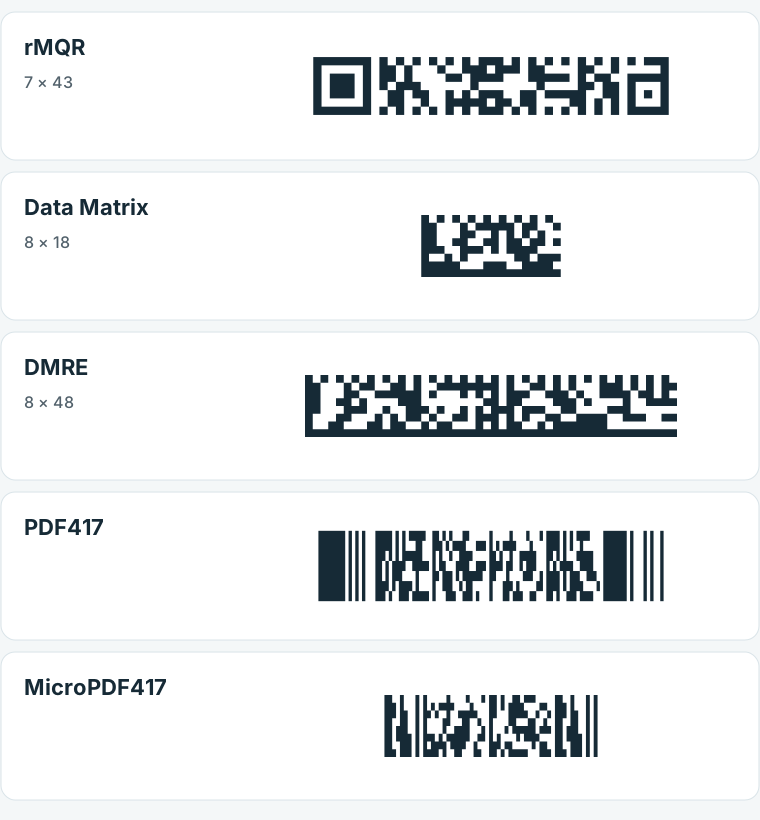
These examples were produced by an encoder, not drawn by hand. Each is scaled independently for readability, so their displayed sizes do not compare capacity or minimum printing area. The sample value “1234” is demonstration data, not a shipping or product identifier.
| Format | Visual clues | What it means |
|---|---|---|
| rMQR | A rectangular grid with a large finder square and a smaller auxiliary finder | A purpose-designed rectangular member of the QR family |
| Rectangular Data Matrix | Two solid adjacent borders form an L; the other borders alternate dark and light | Rectangular sizes of Data Matrix |
| DMRE | Data Matrix border features with additional elongated layouts | Extended rectangular sizes requiring compatibility checks |
| PDF417 | Rows of short bars and spaces stacked vertically | A stacked 2D barcode used on some FedEx labels |
| MicroPDF417 | A compact stack with boundary structures different from PDF417 | A separate PDF417-derived format, not a shrunken PDF417 image |
| iQR | Supports square and rectangular layouts | Another DENSO WAVE format, distinct from rMQR |
Appearance helps narrow the possibilities. Use a decoder to identify the format: glare, cropping, low resolution and unsupported formats can all prevent a successful read.
Standards and licensing: do you have to pay to use them?
Separate permission to use a symbology, the price of a standards document, software or scanner costs, and charges for business identifiers or services. Buying a standard does not assign a product number. Generating a free image does not issue a GS1 identifier or a valid carrier shipping label.
| Format | Main specification | What can be established about licensing and fees |
|---|---|---|
| rMQR | ISO/IEC 23941:2022 | DENSO WAVE explicitly states that it can be used freely; tools, SDKs and equipment may still cost money |
| Data Matrix, including traditional rectangular sizes | ISO/IEC 16022:2024 | A publicly used symbology; ordinary generation and printing do not require buying a license for each symbol. GS1 identifiers and software services are separate |
| DMRE | ISO/IEC 21471:2025 | Its extended sizes have a separate standard. An ISO number does not establish that every implementation is free; check the implementation's license |
| PDF417, including Compact PDF417 | ISO/IEC 15438:2015 | The standard's introduction expressly describes the symbology as public domain, without user restrictions, licenses or fees |
| MicroPDF417 | ISO/IEC 24728:2006 | A separate published standard. The public material reviewed did not provide the same explicit licensing declaration as PDF417; confirm the terms of a commercial implementation |
| iQR | DENSO WAVE's iQR specification | A product description is not a license. We did not verify terms supporting a blanket free-use claim; confirm them with the supplier |
These editions were checked for this article. Traditional rectangular Data Matrix and DMRE have separate specifications; support for one does not establish support for the other. Data Matrix standard, DMRE standard, MicroPDF417 standard
rMQR's free-use statement comes from its developer; PDF417's comes from the standard's introduction. GS1's General Specifications also describe Data Matrix's public-domain history. For DMRE, MicroPDF417 and iQR, absence of a discovered fee is not treated here as an unconditional licensing guarantee. DENSO WAVE rMQR announcement, PDF417 introduction, GS1's Data Matrix background
Internal part identification can use internal numbers. If a trading partner requires GS1 DataMatrix, follow its data rules and use identifiers you are entitled to use. Ordinary Data Matrix and GS1 DataMatrix differ in their data requirements; similar-looking artwork does not establish compliance.
Typical applications
rMQR: narrow space and a QR-family format
rMQR suits labels with limited height, slender parts and form margins. Its rearranged finder structures fit short identifiers or data into narrow areas. DENSO WAVE discusses part traceability, medical equipment and pharmaceutical management, and manufacturing labels as applications. These possibilities do not override an industry's required data carrier. rMQR technical overview
A factory with confirmed reader support could use it for internal part numbers. A public-facing web link also needs compatibility with customers' phone cameras; saving height alone is not enough reason to change formats.
Rectangular Data Matrix and DMRE: parts and traceability
Data Matrix is used for small-item identification, manufacturing traceability and healthcare supply chains. Rectangular layouts suit narrow marking areas; DMRE adds more elongated size options. A scanner supporting ordinary Data Matrix does not automatically support every DMRE size. GS1 DataMatrix guideline, DMRE scope
Direct marking on metal or plastic also depends on lighting, reflections and mark quality. A value that scans on a paper label may be harder to read when marked directly on a part.
PDF417: shipping labels and data-rich documents
The horizontal, multi-row 2D pattern on the FedEx label discussed here is PDF417, not rMQR. FedEx's Ship API documentation explicitly specifies PDF417 printing parameters. FedEx Ship API documentation
A label's linear barcode, its PDF417 symbol, and a QR code used for in-store label printing may serve different purposes. Creating PDF417 artwork does not create a valid shipment, booking or tracking number. Use carrier-provided labels or an approved integration for shipping workflows.
MicroPDF417 and iQR: specialized workflows
MicroPDF417 targets applications that need less area without PDF417's maximum capacity, including compact labels and some composite-code applications. It has its own structure, fixed size combinations and error correction, and requires explicit decoder support. MicroPDF417 specification
iQR also supports narrow layouts and direct part marking. It is distinct from rMQR. Confirm the encoder, reader and license together before choosing it. DENSO WAVE iQR overview
Minimum size: count modules, then calculate millimeters
A module is a basic element of the symbol. For matrix codes, think of a small square. For stacked formats such as PDF417, X is the narrowest bar or space width; row height is a separate measurement. Matrix dimensions below are rows × columns, or height × width, excluding quiet zones.
| Format | Small sizes or structural limits | Important qualification |
|---|---|---|
| rMQR | Lowest-height option: 7×43; a narrower option is 11×27; maximum: 17×139 modules | Minimum height and minimum width cannot be combined into a nonexistent 7×27 version |
| Traditional rectangular Data Matrix | Minimum: 8×18; six sizes: 8×18, 8×32, 12×26, 12×36, 16×36 and 16×48 | The minimum square Data Matrix size is not the minimum rectangular size |
| DMRE | Additional sizes include 8×48, 8×64 and 8×96 | Choose a supported size, not arbitrary row and column counts |
| PDF417 | 3–90 rows and 1–30 data columns | Data columns are not individual module columns; structure, data and error correction must all fit, so not every combination is usable |
| MicroPDF417 | 1–4 data columns and 4–44 rows in prescribed combinations | Do not combine the two minima into a supposed one-column, four-row minimum |
| Rectangular iQR | Prescribed sizes from 5×19 to 43×131 modules | These are not ordinary QR or rMQR dimensions |
Sources: rMQR specifications, GS1 DataMatrix guideline, Zint's format and size documentation, iQR specifications. Zint's documentation is a useful encoder implementation reference; formal acceptance still depends on the applicable standard and business rules.
Why there is no universal “2 mm minimum”
Physical size depends on module size, quiet zones, content, error correction, printing equipment and scanning distance. For a matrix symbol:
Overall width = (columns + left quiet-zone modules + right quiet-zone modules) × X
Overall height = (rows + top quiet-zone modules + bottom quiet-zone modules) × X
Assume the data fits and X = 0.25 mm:
Units: mm
| Example | Quiet-zone assumption | Overall width × height |
|---|---|---|
| rMQR 7×43 | 2X on each side | 11.75 × 2.75 |
| rMQR 11×27 | 2X on each side | 7.75 × 3.75 |
| Rectangular Data Matrix 8×18 | 1X on each side | 5.00 × 2.50 |
rMQR's 2X margin can be cross-checked in Zint's implementation; Data Matrix's 1X margin is documented by GS1. Zint quiet-zone implementation, GS1 guideline
These are geometric examples with stated assumptions, not universal minimum printing sizes or equal-capacity comparisons. A long URL may not fit the smallest version. Industry requirements may also impose larger modules, margins or quality grades.
Prefer whole printer dots per module. At a native density of 8 dots/mm, two dots give X=0.25 mm; at 12 dots/mm, three dots give the same width. Use the manufacturer's actual dot density rather than treating a nominal DPI label as an exact measurement.
FedEx provides a practical example of application-specific requirements: its PDF417 label parameters specify two dots at nominal 203 DPI and three at 300 DPI. These are not universal PDF417 minima. FedEx printing parameters
How widespread is scanner support?
Separate whether hardware captures the symbol, whether software decodes it, and whether the business system accepts its data. Reading text successfully does not establish acceptance by a receiving system.
| Format | Professional readers and software | What to verify |
|---|---|---|
| PDF417 and traditional Data Matrix | Established support in professional 2D scanners and major decoding SDKs | Model, enabled settings and rectangular-size support |
| MicroPDF417 | Explicitly supported by some devices and SDKs | PDF417 support does not imply MicroPDF417 support |
| rMQR | Supported by available scanners and decoders | Exact model/version, explicit rMQR support and firmware requirements |
| DMRE | Extended-size support requires checking | A generic Data Matrix listing is not a guarantee for every DMRE size |
| iQR | Supported by relevant products, including DENSO WAVE products | An explicit iQR listing, not merely QR support |
Official Android and iOS SDKs, and ZXing
For Android, this comparison covers Google's ML Kit Barcode Scanning SDK. Apps must integrate it; it is not a promise about every Android phone's built-in camera. For iOS, it covers Apple's Vision and AVFoundation frameworks.
The table concerns reading/decoding, not generation. It was checked on September 25, 2026, against ZXing Java 3.5.4 and ZXing-C++ 3.1.1. Older releases and wrappers can differ.
| Format | Android: Google ML Kit | iOS: Apple Vision / AVFoundation | ZXing Java 3.5.4 | ZXing-C++ 3.1.1 |
|---|---|---|---|---|
| Ordinary QR Code, for comparison | Supported | Supported | Supported | Supported |
| rMQR | Not in the official support list | Not in the official support list | Not supported | Supported |
| Traditional rectangular Data Matrix | Data Matrix supported; see note 1 | Data Matrix supported; see note 1 | Supported | Supported |
| DMRE | Extended-size support not explicitly guaranteed | Extended-size support not explicitly guaranteed | Supported; DMRE decoding sizes included | Supported; DMRE decoding sizes included |
| PDF417 | Supported | Supported | Supported | Supported |
| MicroPDF417 | Not in the official support list | Supported; see note 2 for OS versions | Not supported | Supported |
| iQR | Not in the official support list | Not in the official support list | Not supported | Not supported |
1. A Data Matrix format entry is not a size-by-size guarantee. Google and Apple both expose Data Matrix support, but their public interface lists do not individually document every rectangular size or DMRE coverage. Test the intended size. Google also requires Data Matrix to intersect the image center, limiting recognition to one Data Matrix per image. Google ML Kit Android documentation, Apple Vision formats, Apple AVFoundation formats
2. MicroPDF417 has minimum iOS versions. Vision's VNBarcodeSymbology.microPDF417 is available from iOS 15.0; AVFoundation's AVMetadataObject.ObjectType.microPDF417 from iOS 15.4. Enable formats according to the API, OS and runtime capabilities. Apple's Micro QR support is not rMQR support. Vision MicroPDF417, AVFoundation MicroPDF417
3. ZXing implementations have different coverage. The classic Java project and the independently developed C++ project must be checked separately. Java 3.5.4 includes traditional rectangular and DMRE decoding sizes. It would be incorrect to say simply that “ZXing cannot read rectangular Data Matrix.” In this comparison, C++ supports rMQR and MicroPDF417 while Java does not. Java format definitions, Java rectangular/DMRE sizes, C++ support list, C++ DMRE sizes
“Not listed” and “not explicitly guaranteed” describe the available documentation, not a hardware experiment proving universal failure. SDK support also does not guarantee support in a phone's camera app or another app. The decoder, enabled formats and image quality all matter.
BarcodeMate uses zxing-wasm, based on ZXing-C++, rather than classic ZXing Java. The article's five examples were successfully decoded locally with the site's zxing-wasm 3.1.4 dependency. This verifies those clean examples, not the success rate of arbitrary photographs.
Professional scanners still require model-specific checks
DENSO WAVE lists rMQR-capable devices and calls for firmware updates. Datalogic exposes MicroPDF417 as a separately configurable format. DENSO rMQR devices, Datalogic MicroPDF417 configuration, DENSO product catalog
An ordinary linear scanner is not a general-purpose 2D reader. PDF417 has also had specialized laser-scanning solutions, so “all 2D barcodes require a camera” is too broad. Check the exact format, minimum module size and working distance, then test the actual label. Accusoft PDF417 documentation
For a web link that passersby should open with their phones, ordinary QR Code remains the first option to consider. Rectangular formats fit workflows where the reader and software can be established in advance.
What does BarcodeMate currently provide?
These existing online generators accept content and export SVG or PNG artwork:
| Generator | Link and current limits |
|---|---|
| rMQR | Rectangular Micro QR generator; currently uses a preset size rather than a full version-selection interface |
| Rectangular Data Matrix | Rectangular Data Matrix generator; for ordinary data; use the corresponding GS1 entry for GS1 data |
| DMRE | Data Matrix Rectangular Extension generator; currently uses a preset size |
| PDF417 | PDF417 generator; creates artwork, not valid carrier labels or identity documents |
| MicroPDF417 | MicroPDF417 generator; a separate format, not scaled-down PDF417 artwork |
To identify an existing image, use the image identification section on BarcodeMate's homepage. You can select a complete symbol with its surrounding quiet zone and retry. Successful decoding shows the format and content. Rectangular Data Matrix and DMRE may both appear as Data Matrix; that result is not an exact-version report.
Decoding runs locally in the browser. An image enters the troubleshooting process only after no barcode is decoded and you explicitly choose to send a sample. Successful images are not automatically uploaded as failed samples. For a PDF document, first take a clear screenshot of the symbol.
There is currently no iQR generator or feature that automatically recommends all rectangular formats from a label's millimeter dimensions. Generation and identification coverage also differ: being able to generate a format does not guarantee that the current reader will decode every version or photograph.
Choosing for your label
- Follow an existing receiving specification first. Do not replace a carrier, GS1 or customer-required format merely because another symbol is smaller.
- For general phone users, consider ordinary QR first. Prioritize practical scanning before optimizing label layout.
- For a controlled workflow with narrow space, compare rMQR and rectangular Data Matrix. Content capacity and installed readers matter more than appearance. Evaluate DMRE when extended proportions are actually needed.
- For larger document payloads, evaluate PDF417. Consider MicroPDF417 when the workflow explicitly supports it and the data fits.
- Validate actual data with actual equipment. Preserve quiet zones, print at the intended size, and check both decoding and acceptance by the business system.
Frequently asked questions
Can I stretch an ordinary QR code into a rectangle?
Nonuniform stretching is not a valid rectangular encoding method. Choose an appropriate symbology and encode the content again instead of changing the shape of existing modules.
Is the multi-row 2D barcode on that FedEx label rMQR?
No. It is PDF417, not rMQR. PDF417 is a stacked symbology; rMQR is a matrix symbology with a different structure and reader support. This refers to the multi-row 2D pattern discussed here; the label's ordinary linear barcode is another pattern. FedEx technical documentation
Which rectangular 2D barcode is smallest?
There is no context-free winner. Lowest height, smallest area, payload capacity, error correction and reader requirements are different comparisons. Fix the data and operating conditions, then compare physical dimensions including quiet zones.
Does a multilingual website mean every format can encode all those languages?
No. Interface language and the character encoding inside a symbol are separate. BarcodeMate currently restricts characters in its ordinary Data Matrix and PDF417 inputs. Follow the generator's guidance for other-language text; interface localization does not imply arbitrary Unicode support in every encoder.
Sources and current website capabilities checked on September 25, 2026. Compatibility depends on the specific device, firmware, application and physical test.